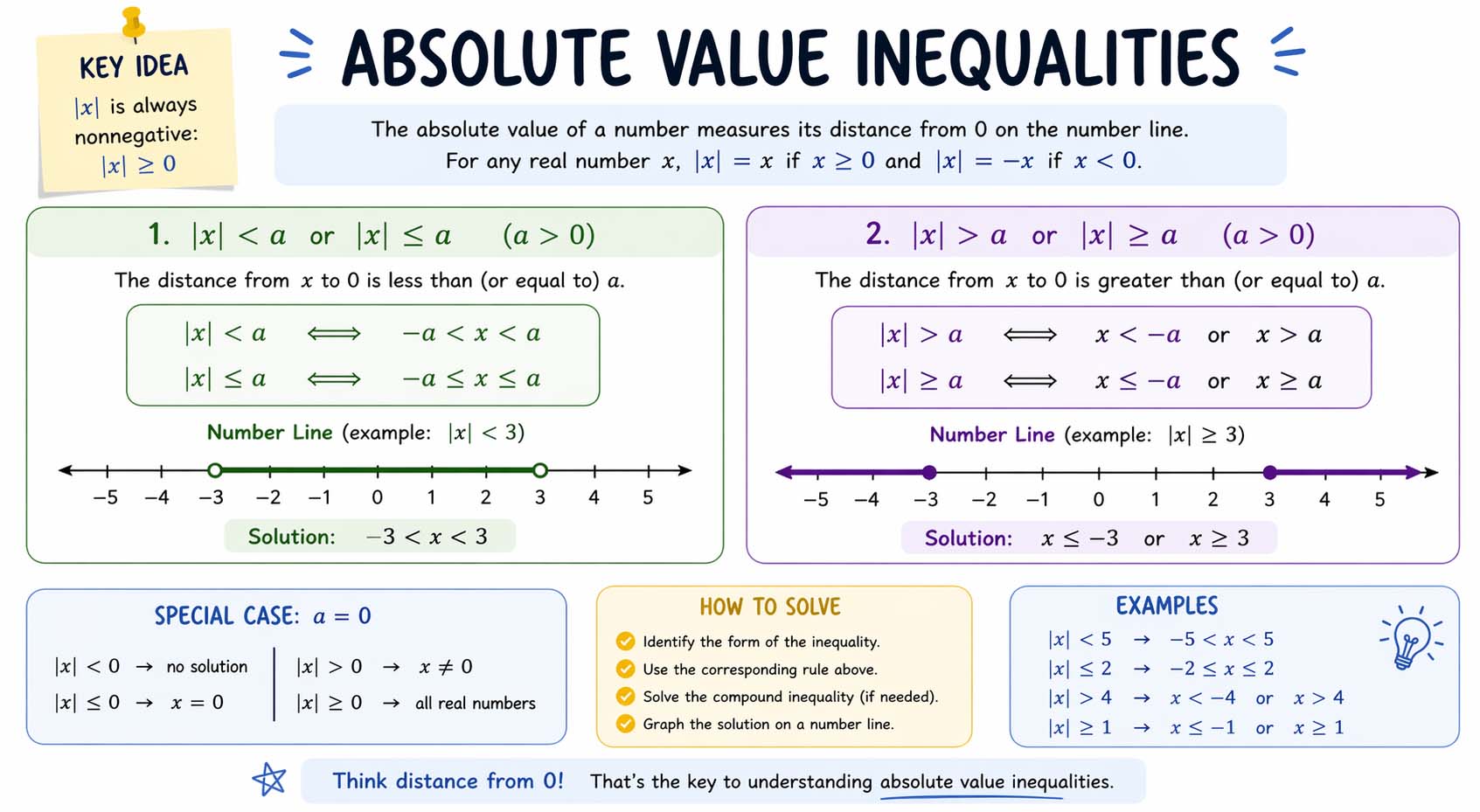
Absolute value inequalities are an important topic in algebra that help students understand how to solve mathematical statements involving distance from zero. Because distance cannot be negative, absolute value always gives a positive result or zero.
When inequalities involve ue, they compare distances rather than exact values. These problems are common in algebra, standardized tests, and higher-level math courses. Once you understand the rules, solving inequalities becomes much easier.
What Is Absolute Value?
Absolute value refers to the distance of a number from zero. It is written using vertical bars.
For example:
∣5∣=5
∣−5∣=5
Both positive five and negative five are five units away from zero, so their absolute value is the same.
This concept becomes useful when solving inequalities because it helps measure ranges of values.
What Are Absolute Value Inequalities?
An absolute value inequality contains an absolute value expression and an inequality sign such as:
- Greater than (>)
- Less than (<)
- Greater than or equal to (≥)
- Less than or equal to (≤)
Example:
∣x∣<3
This means the distance between x and zero is less than three.
Another example:
∣x∣>4
This means x is more than four units away from zero.
Rules for Solving Absolute Value Inequalities
There are two main types of absolute value inequalities.
1. Less Than Inequalities
When the inequality uses less than signs, the solution is between two values.
Example:
∣x∣<5
This becomes:
−5<x<5
So x can be any number between negative five and five.
2. Greater Than Inequalities
When the inequality uses greater than signs, the solution is outside two values.
Example:
∣x∣>3
This becomes:
x<−3 or x>3
So x must be less than negative three or greater than three.
How to Solve Absolute Value Inequalities Step by Step
Let’s solve a more advanced example.
Solve:
∣2x−1∣≤7
Step 1: Rewrite as a compound inequality
−7≤2x−1≤7
Step 2: Add 1 to all parts
−6≤2x≤8
Step 3: Divide all parts by 2
−3≤x≤4
So the solution is all numbers from negative three to four.
Graphing Absolute Value Inequalities
Graphing helps visualize the solution set on a number line.
For:
∣x∣<2
You shade the numbers between negative two and two.
For:
∣x∣>2
You shade numbers less than negative two and greater than two.
Closed circles are used for ≤ or ≥, while open circles are used for < or >.
Real-Life Uses of Absolute Value Inequalities
Absolute value inequalities are not just classroom exercises. They are used in many real-world situations.
Engineering
Engineers use tolerance ranges when manufacturing parts. A machine part may need to stay within a small acceptable range.
Finance
Analysts measure how far prices move from expected values.
Science
Scientists compare errors and distances from target measurements.
Navigation
GPS systems calculate distances and acceptable margins.
Common Mistakes to Avoid
Students often make simple errors when solving absolute value inequalities. Here are some common ones:
Forgetting Two Solutions
For greater than problems, there are usually two solution regions.
Mixing Up Signs
Remember:
- Less than = between values
- Greater than = outside values
Not Isolating Absolute Value First
Always solve until the absolute value expression stands alone before applying rules.
Ignoring No Solution Cases
If an absolute value is less than a negative number, there is no solution because absolute value cannot be negative.
Example:
∣x∣<−1
No solution exists.
Practice Examples
Example 1
Solve:
∣x+2∣<4
Rewrite:
−4<x+2<4
Subtract 2:
−6<x<2
Example 2
Solve:
∣3x∣>9
Divide by 3:
∣x∣>3
Final answer:
x<−3 or x>3
Why This Topic Matters
Understanding absolute value inequalities builds algebra skills needed for equations, graphing, functions, and advanced mathematics. It also improves logical thinking and problem-solving.
Students who master this concept often find later algebra topics easier because inequalities appear throughout mathematics.
Conclusion
Absolute value inequalities may look difficult at first, but they become simple once you understand the meaning of distance from zero. Less than inequalities create a range between two numbers, while greater than inequalities create solutions outside two numbers.
By practicing step-by-step solving, graphing answers, and avoiding common mistakes, you can master absolute value inequalities with confidence. Whether for school exams or future math studies, this topic is a valuable algebra skill.