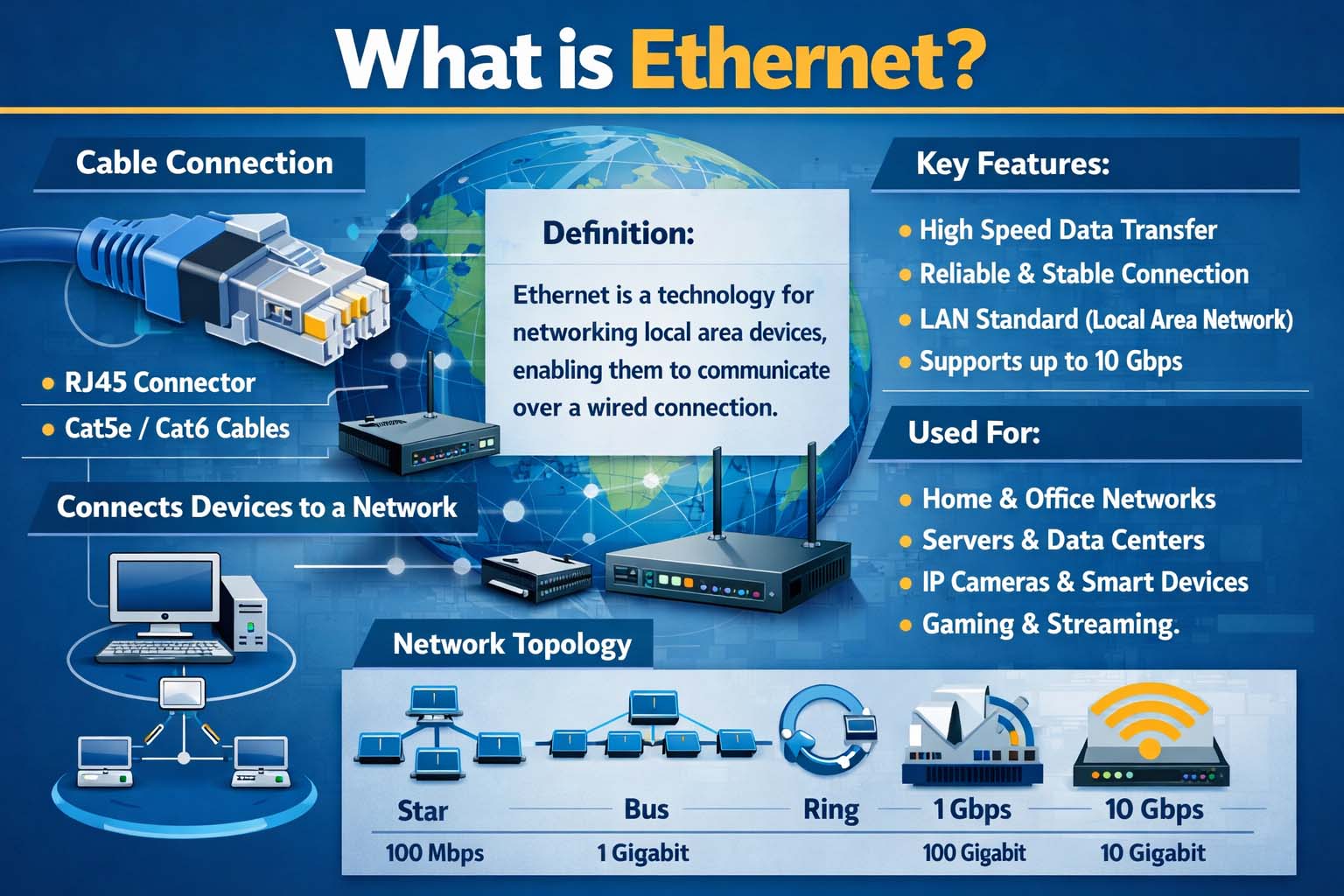
If you have ever wondered what is , you are not alone. is one of the most common technologies used to connect devices in homes, offices, schools, and data centers. It allows computers, routers, gaming consoles, printers, and many other devices to communicate through a wired network.
Even in a world dominated by Wi-Fi, remains highly valuable because it offers fast speeds, low latency, and reliable performance. transferring files, or running a business network, is often the preferred solution for stability and speed.
This guide explains what is, how it works, the different cable types, and why it continues to be important today.
What Is Ethernet?
is a wired networking technology that connects devices within a local area network (LAN). It uses cables and networking hardware to transfer data between devices.
In simple terms, lets devices communicate through physical connections rather than wireless signals. For example, when your computer is connected to a router using a network cable, that is usually an connection.
Ethernet is widely used because it is:
- Fast
- Reliable
- Secure
- Stable
- Easy to scale
It has become the global standard for wired networking.
How Ethernet Works
sends data in small units called packets. These packets travel through cables from one device to another using networking equipment such as switches and routers.
Example:
- A computer requests a website
- The request travels through an cable to the router
- The router connects to the internet
- Data returns through the cable to the computer
This process happens almost instantly.
Modern networks are highly efficient and can handle many devices at the same time.
Main Components of Ethernet
Several parts help function properly.
Ethernet Cable
The physical cable connecting devices.
Router
Connects your local network to the internet.
Switch
Allows multiple devices to connect within one network.
Network Interface Card (NIC)
Built into most devices to support connections.
Modem
Often used with routers to connect internet service to the network.
Together, these parts create a working wired network.
Types of Ethernet Cables
Ethernet cables come in different categories, often called “Cat” cables.
Common Types:
Cat5e
Supports gigabit speeds and common home use.
Cat6
Faster performance with better shielding.
Cat6a
Higher speeds over longer distances.
Cat7
Advanced shielding and premium performance.
Cat8
Used for data centers and very high-speed networking.
Choosing the right cable depends on your internet speed and network needs.
Ethernet vs Wi-Fi
Many people compare Ethernet and Wi-Fi. Both have benefits.
Ethernet Advantages:
- More stable connection
- Lower latency
- Faster consistent speeds
- Better for gaming
- Less interference
- Improved security
Wi-Fi Advantages:
- Wireless convenience
- Mobility
- Easy device connection
- No cables required
For maximum performance, many users combine both.
Why Ethernet Is Still Popular
Even with modern wireless technology, remains important for users who need dependable performance.
Common Reasons:
- Competitive gaming
- Video conferencing
- Streaming in high quality
- Large file transfers
- Business networks
- Smart home hubs
- Office workstations
Ethernet Speeds Explained
Ethernet has evolved significantly over time.
Common Speed Levels:
- 10 Mbps (older systems)
- 100 Mbps (Fast )
- 1 Gbps (Gigabit )
- 2.5 Gbps
- 5 Gbps
- 10 Gbps and higher
Many modern homes now use gigabit equipment.
What Is Used For?
Ethernet is used in many environments.
Home Uses:
- PCs and laptops
- Gaming consoles
- Smart TVs
- Streaming devices
- Printers
Business Uses:
- Office computers
- Servers
- Security systems
- VoIP phones
- Shared printers
Industrial Uses:
- Manufacturing systems
- Automation networks
- Control equipment
Its flexibility makes useful almost everywhere.
Is Ethernet Better for Gaming?
Yes, many gamers prefer because it offers:
- Lower ping
- Reduced lag spikes
- Stable download speeds
- Reliable multiplayer performance
For competitive gaming, is often superior to wireless connections.
Is Ethernet More Secure?
Ethernet can be more secure than Wi-Fi because physical access is usually required to connect. Wireless networks broadcast signals that can be targeted if poorly secured.
That said, all networks still need:
- Strong passwords
- Updated firmware
- Firewalls
- Safe browsing habits
Security depends on setup and management.
Easy Setup at Home
Setting up is simple.
Basic Steps:
- Connect router to modem
- Plug cable into router
- Connect other end to device
- Wait for connection detection
- Test internet speed
Most devices connect automatically.
Common Ethernet Problems
Sometimes users face issues.
Typical Problems:
- Damaged cable
- Loose connections
- Router malfunction
- Outdated drivers
- Wrong port settings
Replacing cables and restarting devices often solves simple problems.
Does Ethernet Work Without Internet?
Yes. can create a local network even without internet access.
Example uses:
- File sharing between computers
- Local gaming network
- Printer sharing
- Internal office systems
Internet is separate from the local Ethernet network.
Future of Ethernet
smarter networking hardware. It remains essential in:
- Data centers
- Offices
- Cloud infrastructure
- Homes with fiber internet
- Professional gaming setups
As internet speeds rise, Ethernet stays relevant.
Common Questions
Is Ethernet faster than Wi-Fi?
Usually yes, especially in consistency and latency.
What cable does use?
Usually Cat5e, Cat6, Cat6a, or higher network cables.
Can laptops use ?
Yes, directly or through USB adapters.
Is Ethernet old technology?
It is older than Wi-Fi but still modern, upgraded, and widely used.
Conclusion
So, what is ? It is a reliable wired networking technology that connects devices using cables for fast and stable data transfer. From homes to global businesses, powers countless connections every day.
Its speed, low latency, security, and consistency make it ideal for gaming, streaming, office work, and professional environments. While Wi-Fi offers convenience, remains the gold standard for users who want the best possible network performance.